
This post contains affiliate links (you can read my full disclosure here).
If you’re a credentialed professional and you’ve decided you should have a newsletter for your small business, you’ve probably noticed that people use the terms “newsletter” and “email marketing” somewhat interchangeably.
And you might be wondering: what’s the actual difference? Does it matter which one I’m doing? And does it really matter what I call it?
What is email marketing?
I define email marketing as educational and/or promotional email messages sent via an email service provider or newsletter platform to a group of people who have opted in, or given you permission to receive those emails. They can also revoke that permission at any time.
It’s what Seth Godin, a renowned marketer, defines as permission marketing:
“Permission marketing is the privilege (not the right) of delivering anticipated, personal and relevant messages to people who actually want to get them.”
It’s NOT BCCing a list of email addresses you’ve collected over the years or scraping emails from people you’ve interacted with on LinkedIn.
A few other definitions that I find helpful in thinking about email marketing include Josh Spector’s definition of it being a “value delivery tool”, or Yuval Ackerman defines it as “relationship-building channel.” I also look at it as a visibility and trust-building tool.
What is the difference between email marketing and a newsletter?
I believe that email marketing exists on a spectrum that ranges from purely informative all the way to selling. On one end, you have pure information and ideas. On the other end, you have selling.
A newsletter, which Merriam-Webster defines as “a small publication (such as a leaflet or newspaper) containing news of interest chiefly to a special group”, is where dissemination of information and ideas is nestled.
Here’s what that looks like in practice:
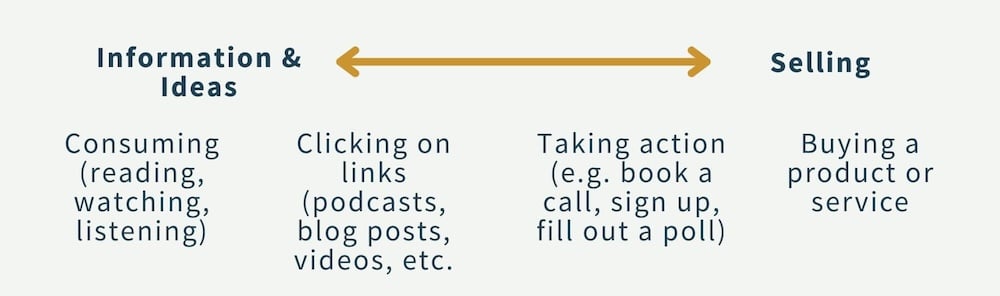
On the information end of the spectrum, people on the receiving end – or your subscribers – are just consuming content. They’re reading the actual words in your email, or maybe watching a video or listening to something, depending on what platform you’re using. This end is about you sharing your ideas and thoughts with people.
Moving a little further along, you might want them to click on a link – maybe to watch a YouTube video, listen to a podcast, or read a blog post you wrote. It’s still more information and ideas rather than selling, though embedded in those external links you might be doing some selling.
Moving more into the selling side, you might ask your subscribers to take some sort of action beyond just passively clicking a link. That might be booking a call, signing up for a workshop, or filling out a poll. (And filling out a poll can range from simply clicking on a link to select an option to asking people to reply.)
And all the way over on the selling end, you’re actually asking for the sale. Telling people about your products or services, maybe sharing testimonials or case studies, but the goal is to make money. These emails can be informative, but the goal is typically transactional.
The Venn Diagram: Newsletter vs. Email Marketing
Another way to think about this is with a Venn diagram:
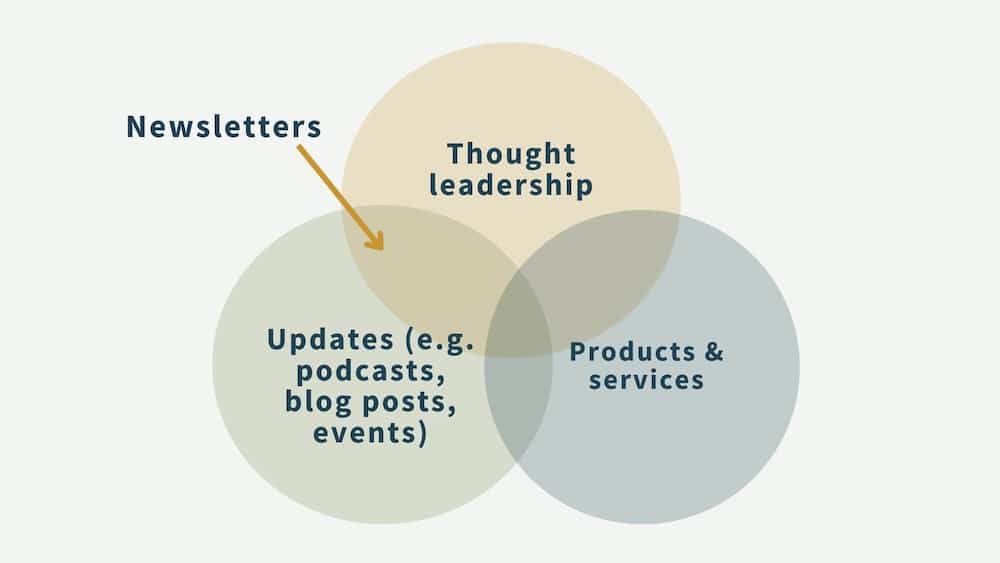
In one circle, you have Thought Leadership: your ideas, observations, perspectives on your field.
In another circle, you have Updates: announcements about new podcast episodes, blog posts, events, what’s happening in your practice.
And in the final circle you have Products & Services: the things you’re actually selling.
A newsletter typically sits at the intersection of thought leadership and updates. You’re sharing your thoughts and ideas, and you’re keeping people informed about what you’re creating and what’s happening in your world.
Email marketing encompasses all three: thought leadership, updates, AND selling your products and services.
Sometimes “selling” looks like “I have this program I need to fill, so I’m going to send daily emails for a week promoting it.”
But it can also be more subtle and ongoing. For example, the way I typically structure my Automate with Heart newsletter is through storytelling and bringing it back to a concept in email marketing. I’m pretty much always pointing back to my email marketing services, but I try to make sure that people get value out of my newsletter whether or not I’m actively pushing for a sale.
My way of doing my newsletter sits in that area where the Thought Leadership and Products and Services circles overlap. It’s less common that my newsletter fit into the Updates bucket, unless I’ve guested on a podcast and I want to promote that.
You can move along this spectrum based on what your practice needs at any given time. Sometimes you’re just staying in touch. Sometimes you’re letting people know you have openings. Both are valid.
Understanding where you fall on this spectrum is crucial because different platforms are designed for different purposes.
Email marketing platforms like Kit, Mailchimp, Mailerlite, and Flodesk can handle all three purposes.
Newsletter platforms like Substack are really intended for just the first one: thought leadership.
Is a newsletter considered marketing?
While a newsletter might not feel like email marketing because you’re not selling something, you are in fact marketing: you’re marketing your ideas.
What you’re not necessarily doing is selling in the sense that there’s not an exchange of money for sharing your ideas (unless you have a paid newsletter, but that’s a whole other business model).
But if you’re running a service-based business, your newsletter is still working for you – it’s building visibility and trust with your audience. When someone needs what you offer, you’re top of mind because you’ve been showing up consistently in their inbox, sharing valuable insights and establishing yourself as someone who understands their world.
The beauty of understanding this spectrum is that you get to choose where you want to be at any given time.
There’s no “right” way to do this, only what serves your business and your subscribers best.
Where do you fall on the email marketing spectrum?
Take a moment to think about your current email practice:
- Where does your newsletter sit on the spectrum right now?
- Where do you want it to be?
- Are you using a platform that supports your goals?
Understanding where you are, or where you’re headed, will help you make better decisions about everything from which platform to use to what you write about to how often you send.